
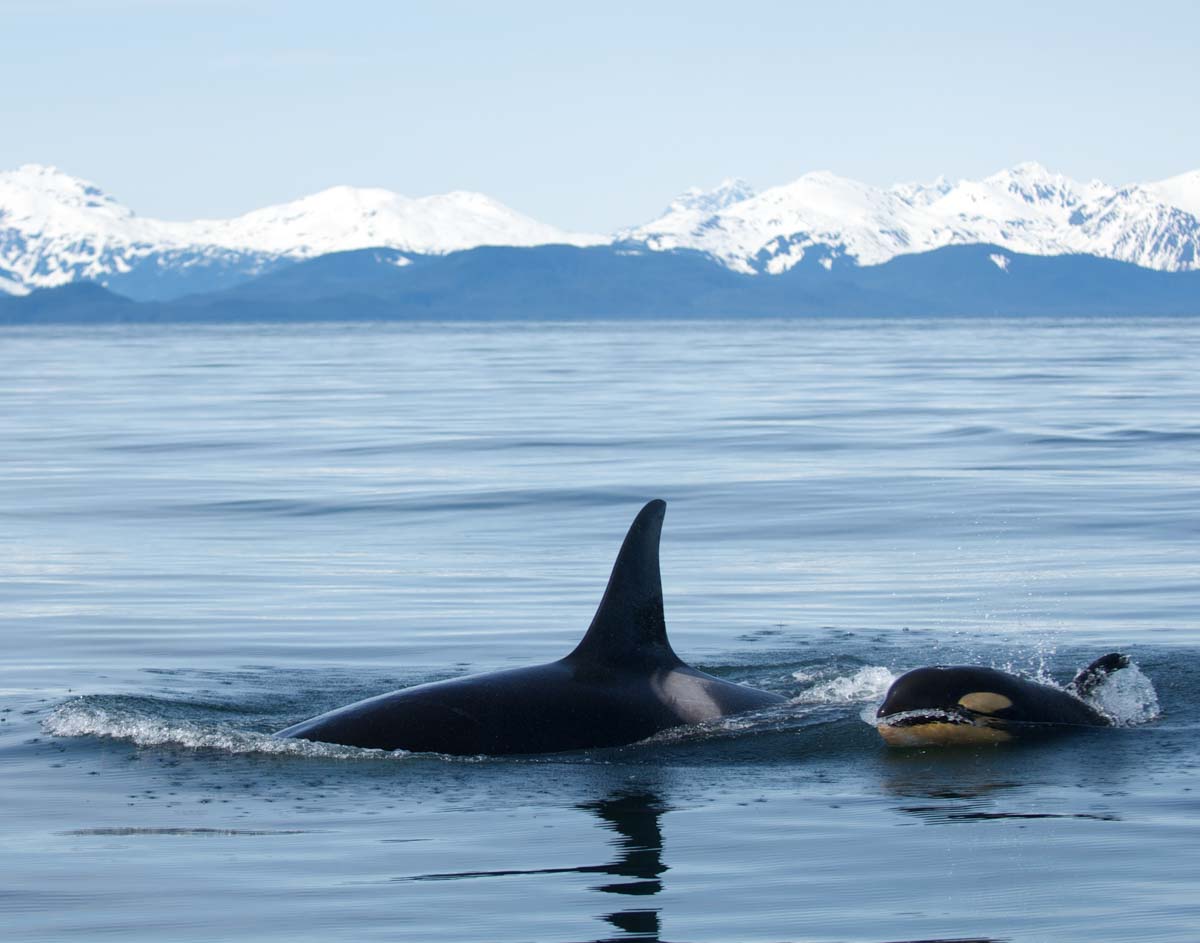
Juneau Whale Watching + Ocean Therapy: A Mindful Way to Experience Southeast Alaska
If you are searching for Juneau whale watching and want something more meaningful than a standard sightseeing trip, our new Whale Watching + Ocean Therapy tour offers a slower, more intentional experience on the water.
Our Juneau whale watching ocean therapy tour is a private 3-hour, small-group experience (up to 6 guests) offered during the May–September season in Southeast Alaska.
This is not a medical treatment, and it is not wellness marketing with vague promises. It is a guided whale watching trip designed around evidence-informed ideas from nature immersion practices—especially the kind of mindful, sensory attention associated with forest bathing (shinrin-yoku)—adapted to a marine environment. Tanja your guide is certified as n ANFT Forest Therapy Guide and as an Ocean Therapy Practitioner.
Our goal is to help guests experience Southeast Alaska with more presence, more awe, and less rush.
What Is Ocean Therapy?
“Ocean therapy” is not one standardized clinical method. In travel and nature-based experiences, the term usually refers to intentional time in or near the ocean to support calm, perspective, and overall well-being.
Research on blue spaces (coasts, oceans, rivers, and lakes) suggests that time spent in these environments is associated with improved mood and lower stress for many people.
How Forest Bathing Relates to an Ocean Setting
Forest bathing, or shinrin-yoku, was formalized in Japan as a low-impact way to reconnect with nature through slower movement and sensory attention. Common elements include quiet observation, breathing, noticing sounds, and paying attention to the environment without trying to “perform” the experience.
An ocean environment is not a forest, and the two should not be treated as interchangeable. However, some of the practical elements translate well:
- Slowing the pace
- Reducing constant stimulation
- Using guided sensory attention
- Focusing on direct experience instead of multitasking
On a whale watching boat, that can mean listening for whale blows, watching the rhythm of the water, noticing weather and light, and taking moments of quiet instead of filling every minute with chatter. This is what we mean by mindful whale watching.
Why Whales? The Role of Awe and Nature Connection
Whales are one of the most reliable awe-inducing wildlife encounters available to visitors in Southeast Alaska. Awe matters because research links it to perspective shifts, increased connectedness, and positive emotional outcomes. The experience of simply hearing the exhale breath of a humpback can be powerful. Whales can create moments of scale, wonder, and attention that many people find deeply memorable.
What Guests Often Value Most
- A slower pace than many standard tours
- Time to observe, not just chase sightings
- Small private group consisting of only you/ friends/ family
- A stronger sense of awe and perspective
- A more memorable connection to what you hope to feel in Alaska
What a Whale Watching + Ocean Therapy Tour Looks Like
Tour format: 3-hour small-group tour (up to 6 guests), typically operating May–September, with a whale-watching experience paced to include quiet observation and optional mindful prompts.
A typical trip includes:
- Safety briefing and responsible wildlife viewing orientation
- Transit to whale habitat with local natural history interpretation
- Quiet observation windows (intentional pauses, less constant narration)
- Optional guided prompts for breathing and sensory focus
- Time for photography and questions
- Return to harbor with practical “take-home” ways to build more nature time into daily life
This format works especially well for travelers who want more than a checklist excursion: couples, solo travelers, families, and cruise guests looking for a meaningful Juneau whale watching experience.
Juneau and Southeast Alaska: Why This Is the Right Place
Juneau is one of the best locations for Southeast Alaska whale tours because productive marine habitat is accessible from town and whale activity can often be reached without extremely long runs. Conditions vary with weather, tides, season, and wildlife movement, so no ethical operator should promise a scripted experience.
That variability is part of the value. Ocean therapy is not about controlling nature—it is about participating in it with attention and respect.
Our approach also emphasizes responsible wildlife viewing. In Alaska, humpback whale viewing is regulated, including minimum approach distances and vessel conduct requirements. NOAA guidance exists to protect whales and reduce disturbance, and responsible operators follow it.
Responsible Whale Watching Matters
- Maintain legal distance from whales
- Avoid cutting across whale travel paths
- Reduce disturbance and unnecessary pressure
- Prioritize animal welfare over “getting the shot”
Ethical viewing is better for the whales and better for the long-term guest experience.
How to Prepare for a Mindful Whale Watching Experience
You do not need to do anything unusual. The best approach is to come prepared for Southeast Alaska weather and be ready to slow down.
- Dress in warm layers
- Bring a waterproof outer layer
- Wear stable footwear suitable for dock and boat surfaces
- Bring gloves and a hat on colder days
- Use a camera strap or phone lanyard
- Expect changing weather and sea conditions
- Arrive ready to observe, not just collect photos
Who This Tour Is For
This tour is a strong fit for guests who want:
- A nature-focused experience in Juneau
- A calmer alternative to fast-paced sightseeing
- An evidence-informed take on ocean therapy and nature wellness
- A memorable wildlife encounter rooted in respect for place and animals
It may be less ideal for guests who want a high-energy, nonstop narrated trip without quiet observation periods. (If that’s your preference, a standard whale watching format may be a better fit.)
Book Your Juneau Whale Watching + Ocean Therapy Tour
If you want a Juneau whale watching trip that combines wildlife viewing, local knowledge, and a more mindful pace on the water, our Whale Watching + Ocean Therapy tour is built for that.
Book online: https://adventuresinalaskacharters.com/book/
Check availability: Call 907-209-8227 or email [email protected]
Small-group format means more room, better visibility, and a calmer pace for observation.
Safety + Accessibility Note: This is a wildlife-viewing experience, conditions on the water can change quickly and may affect comfort. Our tours are small-group (up to 6 guests) and typically run for 3 hours during the May–September season. Accessibility depends individual mobility needs. Please contact us in advance at [email protected] or 907-209-8227 to discuss boarding, seating, and mobility needs so we can confirm whether this tour is a good fit.
Frequently Asked Questions
Is this a regular whale watching tour or something different?
It is still a whale watching tour, but with a slower, more intentional format. We include quiet observation time and optional sensory-focused prompts instead of treating the trip as a rushed checklist excursion.
What does “ocean therapy” mean on this tour?
It refers to intentional time on the water designed to support calm connection through sensory immersion and mindful attention. It is not medical or mental health treatment.
Is there science behind blue space and nature wellness?
There is growing evidence that time in blue and green spaces is associated with improved well-being and lower stress, but the strength of evidence varies and causality is still being studied.
Do I need experience with mindfulness or meditation?
No. Tanja will guide you through the experience, however generally the focus is simply slowing down, noticing your surroundings, and being present during the whale watching experience.
Is this tour appropriate for families?
Usually yes. The tour is designed as a 3-hour small-group experience (up to 6 guests) and is suitable for many families. Final fit depends on weather, sea conditions, vessel layout, individual mobility or comfort needs. Please contact us in advance to confirm whether it is the right fit for your group.
How close can boats get to humpback whales in Alaska?
NOAA regulations prohibit approaching within 100 yards of humpback whales in Alaska, along with other vessel conduct requirements intended to reduce disturbance.
Sources
- Shinrin-yoku, the Japanese Art of Forest Bathing — Japan National Tourism Organization (JNTO), 2023
https://www.japan.travel/en/japan-magazine/2309_shinrin-yoku-the-japanese-art-of-forest-bathing/ - Effects of Shinrin-Yoku (Forest Bathing) and Nature Therapy on Mental Health: a Systematic Review and Meta-analysis — International Journal of Mental Health and Addiction (Springer), 2022
https://link.springer.com/article/10.1007/s11469-020-00363-4 - The Effects of Forest Therapy on the Blood Pressure and Salivary Cortisol Levels of Urban Residents: A Meta-Analysis — International Journal of Environmental Research and Public Health, 2022
https://pmc.ncbi.nlm.nih.gov/articles/PMC9819785/ - Blood pressure-lowering effect of Shinrin-yoku (Forest bathing): a systematic review and meta-analysis — BMC Complementary and Alternative Medicine, 2017
https://pmc.ncbi.nlm.nih.gov/articles/PMC5559777/ - Green and blue space and mental health (NIHR/NCBI Bookshelf chapter) — 2023
https://www.ncbi.nlm.nih.gov/books/NBK597114/ - Associations between green/blue spaces and mental health across 18 countries — Scientific Reports, 2021
https://www.nature.com/articles/s41598-021-87675-0 - Blue care: a systematic review of blue space interventions for health and wellbeing — Health Promotion International / PMC, 2020
https://pmc.ncbi.nlm.nih.gov/articles/PMC7245048/ - Blue space, health and well-being: A narrative overview and synthesis of potential benefits — Environment International, 2020
https://www.sciencedirect.com/science/article/pii/S0013935120310665 - Wildlife tourism: The psychological benefits of whale watching — Pacific Tourism Review, 1998 (portal record)
https://researchportal.scu.edu.au/esploro/outputs/journalArticle/Wildlife-tourism-The-psychological-benefits-of/991013233513302368 - Awe: A Systematic Review within a Cognitive Behavioural Framework and Proposed Cognitive Behavioural Model of Awe — International Journal of Applied Positive Psychology (Springer), 2024
https://link.springer.com/article/10.1007/s41042-023-00116-3 - Awe of nature and well-being: Roles of nature connectedness and powerlessness — Personality and Individual Differences, 2023 (abstract page)
https://www.sciencedirect.com/science/article/abs/pii/S0191886922004512 - Human–Animal Interactions: Expressions of Wellbeing through a “Nature Language” — Animals, 2021
https://pmc.ncbi.nlm.nih.gov/articles/PMC8067212/ - Biological effects of negative air ions on human health and integrated multiomics to identify biomarkers: a literature review — Environmental Science and Pollution Research, 2023
https://pmc.ncbi.nlm.nih.gov/articles/PMC10175061/ - Alaska Marine Mammal Viewing Guidelines and Regulations / Alaska Humpback Whale Approach Regulations — NOAA Fisheries
https://www.fisheries.noaa.gov/alaska/marine-life-viewing-guidelines/alaska-marine-mammal-viewing-guidelines-and-regulations
https://www.fisheries.noaa.gov/action/alaska-humpback-whale-approach-regulations